
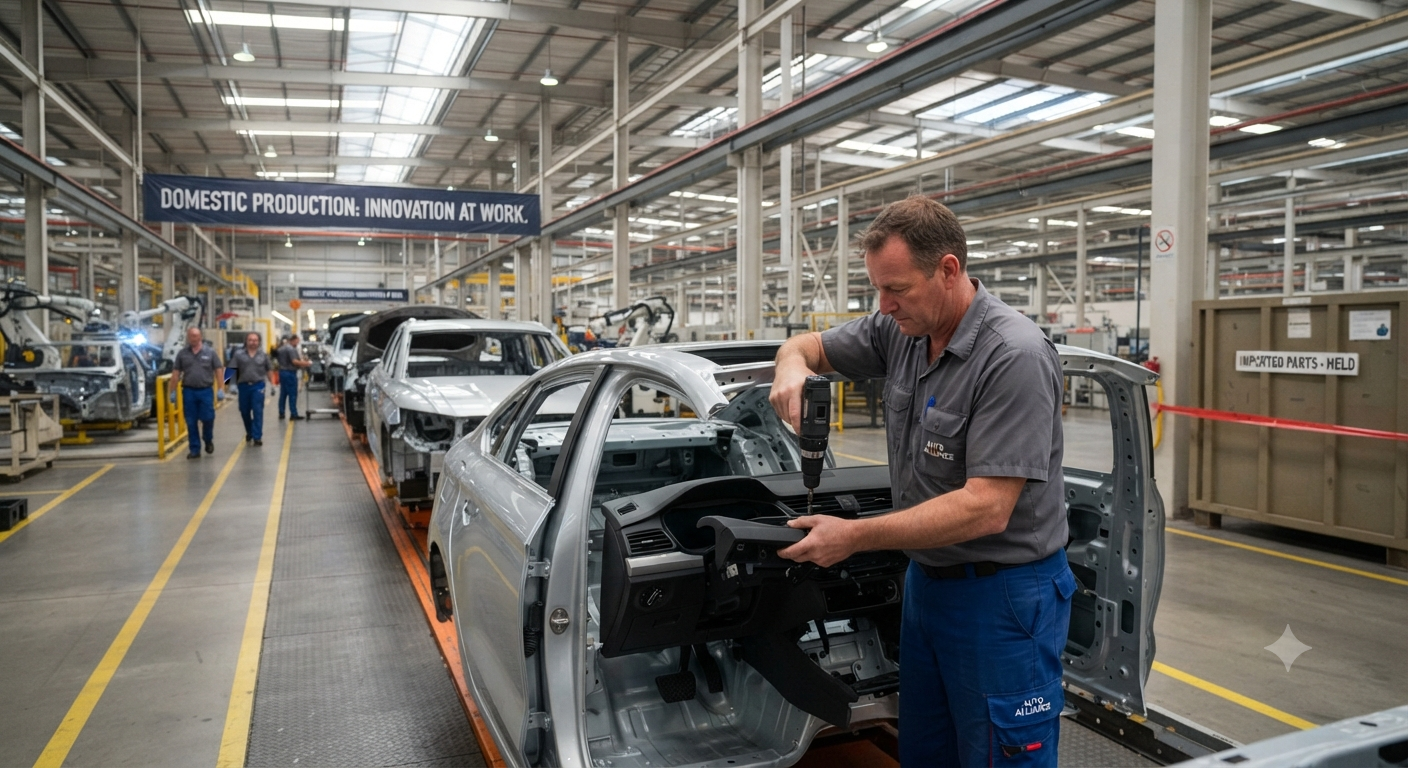
The implementation of aggressive tariff policies in 2025 was designed with a clear, ambitious goal: to incentivize a massive “reshoring” of automotive manufacturing to the United States. By imposing a 25% duty on imported vehicles, parts, and batteries, the U.S. government sought to disrupt global supply chains and force automakers to move production stateside. However, as the industry navigates into 2026, the strategy has failed to yield the anticipated wave of domestic manufacturing growth. Instead, automakers have largely responded with pricing adjustments, modest operational tweaks, and a cautious “wait-and-see” approach rather than the wholesale relocation of production facilities.
The Economic Reality of Reshoring
The fundamental barrier to mass reshoring lies in the deep-seated economic and structural integration of the global automotive supply chain. For decades, manufacturers have relied on a “finely woven” network of suppliers spanning Mexico, Canada, Europe, and Asia.
The Labor Cost Disparity
The financial argument for maintaining foreign operations remains compelling. Labor costs for vehicle production in the U.S. significantly exceed those in Mexico. For the “Detroit Three” automakers, the average labor cost per U.S.-made vehicle is five times higher than those produced in Mexico. Even for Asian car companies with non-unionized U.S. facilities, the cost of domestic production remains three times higher than their Mexican operations. These disparities make a full-scale return to U.S. manufacturing an economically prohibitive prospect for many brands.
Supply Chain Complexity
Automakers face immense difficulty in decoupling from international markets because no vehicle is entirely “made in the U.S.”. Even vehicles assembled domestically often rely on engines, transmissions, and motors sourced from across North America or beyond, all of which became subject to the 25% tariff. The complexity of these integrated chains means that moving production back to the U.S. is not a simple task; it requires years of lead time to build new assembly and parts plants—time that many automakers do not have in a margin-sensitive, fast-evolving market.
Strategic Responses: Why Not Reshoring?
Rather than rushing to build new plants, automakers have prioritized short-term survival and margin protection.
- Absorbing Costs vs. Raising Prices: Most automakers have adopted a hybrid strategy: absorbing a portion of the tariff burden to keep sticker prices competitive while raising vehicle prices enough to protect their bottom lines.
- Capacity Optimization: Some manufacturers have opted to increase production at existing U.S. facilities that previously had idle capacity rather than constructing new ones. This allows them to avoid the massive capital expenditure of greenfield projects while still responding to tariff-related supply constraints.
- Model Lineup Trimming: To mitigate losses on low-margin vehicles that depend heavily on imported components, many automakers have trimmed these models from their U.S. offerings entirely.
The 2026 Landscape: Regionalization over Reshoring
As of 2026, the industry has shifted away from a purely globalized network toward a “regionalized” model. While this is sometimes conflated with U.S. reshoring, it is distinct. Near-shoring—siting production and sourcing within a “friendly” trade bloc like the USMCA—is becoming the industry standard.
Technological and Structural Challenges
The push for electrification has further complicated the situation. Tariffs on lithium-ion batteries have squeezed margins for electric vehicles (EVs), forcing automakers to prioritize battery localization within regional clusters rather than solely within U.S. borders. Furthermore, the industry is currently undergoing a massive “workforce transformation”. There is a critical shortage of high-voltage engineering, robotics, and software talent required for modern, “software-defined” factories. Building this specialized workforce in the U.S. presents a long-term challenge that cannot be solved by tariff policy alone.
Conclusion: A Failed Lever for Change
The 2025 tariff regime has undeniably “rewired” the automotive industry, but not in the direction of total domestic production. Instead, it has driven a wedge between policymakers and manufacturers, creating an environment of unpredictability and heightened trade tensions. The $108 billion in added costs for automakers—$42 billion of which hit the Detroit Three alone—has served as a drag on the sector’s long-term competitiveness rather than a catalyst for a manufacturing renaissance.
Ultimately, the failure of the tariff strategy to drive mass reshoring confirms that global automotive manufacturing is too deeply integrated and economically reliant on international specialization to be forced back within national borders by trade barriers alone. Manufacturers will continue to prioritize flexibility, regional resilience, and software-led innovation over the rigid mandate of domestic-only production.









Leave a Reply